I’m born a traveler. As a three year old I remember the drive south from New York state to visit my snow-birding grandparents in Florida. We were sideswiped in Georgia. After that stay in an over-night flea bag hotel, I’ve traveled north to south, east to west through 42 states. I’ve found comfort in the road. Highlights: The Truman library in Independence, Missouri, Yellowstone’s Old Faithful Inn, InnIndependence Hall in Philadelphia,, and the Royal Hawaiian in Honolulu.
Around ten years ago things changed. Something in my brain rearranged. Click! The cause? I’m not sure. Traffic, congestion, changing lanes, speed, the uncertainly of the road freaked me out. I was hyper-vigilant I worried that anything may end my life. Ease and happiness of traveling was in my past. My present: How can I get to the store without fear.
My memories of travel are very positive. While a young child, I guided my finger through our family road atlas while dad drove from one place to another in Wyoming, and later from Oregon to southern California. Later memories are of reading Little House on the Prairie and The Lion, Witch and Wardrobe to my children while my husband drove through the Colorado Rockies. I also remember (not fondly) the arguments my husband and I had while I tried to navigate unfamiliar states (the mountains of Idaho and Missouri were especially difficult). I remember barbecue in Kansas City, Memphis, and San Antonio, frozen custard in St. Louis, and Tampa’s 1905 Salad. I remember hula pie at Duke’s, vegan in Ojai, and multiple wedding jellos in Montana.
Now days I take deep breathes while motoring to and from the Oregon coast. I pray the mercy prayer driving through the Columbia Gorge, and whisper Jesus, Jesus, Jesus, while we power up and over the scary turns of Mt. Hood. I believe that God goes ahead and behind me in my travels. And I pray.
About a month ago, while traveling through the Columbia Gorge, I fleetingly felt the euphoria I used to feel while traveling. I was, of course, very surprised. The feeling traveled through my mind swiftly. I couldn’t quite reach it, but knew I’d felt it.
This afternoon, while driving 99 toward an appointment to grandma-care for my sweet grandson, I felt that feeling again. The feeling of freedom. The feeling of gliding down the road with no care in the world. The feeling: I HAVE THIS. The euphoric feeling that I am part of a beautiful world and will be okay.
I will persevere. I will trust that God goes before and after me. I will pray.
The Lord’s Prayer, and our Lenten study, begin with “Our Father, who art in Heaven hallowed be Thy name.” They end, “For Thine is the kingdom, the power, and the glory forever”. Worshipful bookends. This week we study how worship can influence our reaction to unanswered prayer.
If you are lucky, God will lead you to a situation you cannot control, you cannot fix, or you cannot even understand. At that point true spirituality begins. Up to that point is all just preparation. Richard Rohr
In 2 Samuel 12, David is out of control and can’t fix the predicament he’s in. God’s prophet Nathan foretold that his sin with Bathsheba would result in the death of their child. David pleads with God for the life of his son for seven days; fasting, in sackcloth, prone on the ground. David went all in: while his son was alive David hoped for healing. He did everything he knew to change the mind of God.
It’s clear that David’s view of God does not change with changes in circumstances. When his son dies, David’s attendants are afraid David will do “something desperate”. Instead David, a very special person, gets off the ground, cleans up and goes to the house of the Lord to worship. David depends upon God’s greatness, power, majesty and splendor before and after the death of his child. David never doubt’s God’s sovereignty.
David admits his emotions, doubts and disappointments to God. Because he expresses his emotions, doubts and disappointments, he is able to regain equilibrium.
I cried out to God for help; I cried out to God to hear me.
When I was in distress, I sought the Lord; at night I stretched out untiring hands, and I would not be comforted.
I remembered you, God, and I groaned; I meditated, and my spirit grew faint.[b]
You kept my eyes from closing; I was too troubled to speak.
I thought about the former days, the years of long ago;
I remembered my songs in the night. My heart meditated and my spirit asked:
“Will the Lord reject forever? Will he never show his favor again?
Has his unfailing love vanished forever? Has his promise failed for all time?
Has God forgotten to be merciful? Has he in anger withheld his compassion?”
Then I thought, “To this I will appeal: the years when the Most High stretched out his right hand.
I will remember the deeds of the Lord; yes, I will remember your miracles of long ago.
I will consider all your works and meditate on all your mighty deeds.”
Your ways, God, are holy. What god is as great as our God?
You are the God who performs miracles; you display your power among the peoples.
Psalm 77:1-14
Later when Bethsheba and David’s son Solomon was chosen to build the temple, David prayed what some say is the basis for the end of The Lord’s Prayer.
Praise be to you, Lord,
the God of our father Israel,
from everlasting to everlasting.
Yours, Lord, is the greatness and the power
and the glory and the majesty and the splendor,
for everything in heaven and earth is yours.
Yours, Lord, is the kingdom;
you are exalted as head over all. 1 Chronicles 29:10&11
When we aren’t in control, fix a situation, and don’t understand what is going on we normally pray. But, after we pray a while, and don’t see answers we should follow the paths of David and Christ. Their responses to unanswered prayers are genuine worship and self-denial. It’s not wrong to go to God with requests that seemingly may not be His will. When God answers in a way we don’t like and we worship Him despite our pain, our offerings to Him are even more special.
“He took Peter, James and John along with Him, and He began to be deeply distressed and troubled”. When facing the cross, Jesus chose to pray with His best friends. Though He was an active part of the Trinity, He also shared His pain with human disciples.
During COVID quarantine we isolated and cocooned.When we go through difficult times, the temptation is to again, isolate and cocoon. The habit of withdrawal is a temptation even when the healthier choice would be to share. When we are asked “How are you?” It isn’t easy to admit that we aren’t fine. When we admit that we are not fine, God can work during honest conversations with people we trust. God can provide answers through helpful words of others.
In addition to to the aid of helpful friends, when we pray the Holy Spirit and Christ pray with us. During an especially difficult time of prayer last week, a friend reminded me that Christ prays along side us. It comforted me that I could, like when I pray with partners, just relax and silently agree with Christ’s prayers.
In the same way, the Spirit helps us in our weakness. We do not know what we ought to pray for, but the Spirit himself intercedes for us through wordless groans. And he who searches our hearts knows the mind of the Spirit, because the Spirit intercedes for God’s people in accordance with the will of God.
… Christ Jesus who died—more than that, who was raised to life—is at the right hand of God and is also interceding for us. Who shall separate us from the love of Christ? Shall trouble or hardship or persecution or famine or nakedness or danger or sword? As it is written:
“For your sake we face death all day long; we are considered as sheep to be slaughtered.”
No, in all these things we are more than conquerors through him who loved us. For I am convinced that neither death nor life, neither angels nor demons, neither the present nor the future, nor any powers,neither height nor depth, nor anything else in all creation, will be able to separate us from the love of God that is in Christ Jesus our Lord. Romans 8:26&27, 34-39.
“And being in anguish, he prayed more earnestly”. Christ’s anguish gave Him the desire to press into His Father more earnestly. Christ prayed, checked in with His disciples, prayed again, checked in, and prayed some more.
He prays three times for deliverance. Making the same request three times is a biblical literary device to signify completeness. Jesus praying three times means that he prayed until he felt he had resolved the issue with himself and with God. MaryKate Morse
Earnest prayer takes time and effort. Think: the persistent widow: Luke 18:1-8. It takes courage, quiet and time to allow God to communicate to us while we are praying. John 10:1-5, Isaiah 30:19-21, John 16:13-15.
“Abba, Father!” Prayer is not always about results. It’s always about relationship. At Gethsemane, while Peter, James and John fell asleep, Jesus communicated His deepest thoughts and emotions to His Father. It was second nature for Jesus to pray to His Father.
For Christ, prayer is communication, both speaking and listening. Read John 5-8. There are numerous references of communication between Christ and God.
It is obvious that Christ didn’t want to go through death on the cross. His relationship with His Father made it possible for Him to do, in the end, what He didn’t want to do.
“Everything is possible for You.”
Ultimately, we cannot limit God’s power and love for us. While He can do anything, there is a disconnect between our reality and His. It’s possible that at times we’d rather not be disappointed by God’s answers to our prayers OR we may be afraid that God will ignore us or not do what we want. We’d rather not share our suffering with Him. In pain, we are capable of disregarding our loving God’s possibilities. Our need for control, to fix things, and to understand, can negatively influence our prayer life. Though we may not deliberately try to limit God, we limit Him in our own eyes. When we fail to honestly share our deepest needs, we limit our view of what God can do.
When our prayers are not answered, we it is easy to doubt God’s love for us. We may believe that our prayer requests are reasonable and just. We may believe that we KNOW WHAT IS BEST FOR US AND we especially know what’s best for OUR LOVED ONES. We might pull away after wondering why God doesn’t make the pain stop.
No matter how hard it is to keep trusting when our deepest, most desperate prayers go unanswered, getting rid of God’s love and God’s power doesn’t actually help. In fact, it makes things much worse. The you try to remove God from the equation of your sufferings, you reduce yourself to a highly evolved animal in a meaningless universe whose suffering is without purpose, consequence, or hope. By holding on to God when things are tough, you retain the possibility of rescue and receive comfort in your distress, a sense of purpose in your pain, and ultimately the hope of a life after death. Pete Greig
Through pain, it is possible to come to a deeper acknowledgement that God knows and loves us and has our best in mind. Isaiah 55:8-13 While everything is possible for God, as our creator, He knows what to best for us. We don’t.
“Take this cup from Me.”Jesus was comfortable praying that He’d like to escape the cross. Christ knew His destiny from the beginning, but as a human, sweat blood in fear of it.
Pete Greig in “How to Pray”, admits, “The Bible is more honest about unanswered prayers than the church. The gospel writers make no attempt to hush up the fact that Jesus himself experienced disappointment in prayer.”
Jesus, like David, who knew what His Father was about. They both asked that they’d be spared. We should find comfort approaching God in our weakness. 2 Corinthians 12:9-11 As we ask for our heart’s desires, we understand more clearly if our heart’s desires spring from God’s desires for us.
“But not My will, but Yours be done.”Jesus is clear with His Father. His Father, in turn is clear with Him. Jesus didn’t want to die, but His Father was for it. Jesus, sweating blood, believed in God’s sovereignty even while He didn’t want to do His Father’s will. Christ was able to continue off the mountain into captivity, and drew the strength to go through His Father’s plan because He knew that it was God’s will. Christ knew His Father had a greater picture.
In retrospect, we understand why Jesus endured the cross, Hebrews 12:1-2. It may not be possible for us to understand our bigger picture now, but we can ask God to supply us with the strength to worship Him and walk beside Him while we still wonder.
When we worship God, not understanding His will, fairness, or lack of connection, we admit God’s lordship in our lives. He becomes dearer: Not only as our Savior, but our Lord, Comforter, Healer, and Peace.
I do not understand what God is doing or even where God is, but I know that he is out to do me good.’ This is trust. This is how to wait. I do not fully understand the reasons for the wildernesses of God’s absence. This I do know; while the wilderness is necessary, it is never meant to be permanent. In God’s time and in God’s way the desert will give way to a land flowing with milk and honey. Richard Foster
Assignment:
When we are disappointed in prayer, praying the Psalms can bring comfort and provide a means of framing our emotions.
These Psalms focus on God’s trustworthyness. Psalm 27: 4-5, Psalm 46, Psalm 91, Psalm 139:1-18. Notice that these Psalms say little about God answering prayers and a lot about His majesty and interest in our welfare. They suggest that we should not fear, but when we do, God is with us. The Psalms also provide comfort that our future is more positive than the present.
They that wait upon the Lord shall renew their strength; they shall mount up with wings as eagles; they shall run, and not be weary; and they shall walk, and not faint.
Isaiah 40:31
References:
Foster, Richard, Prayer Finding the Heart’s True Home, p. 23-24
Greig, Pete, How to Pray, A Simple Guide for Normal People. p. 115,119
Morse, MaryKate, A Guidebook to Prayer, pg. 136
One response to “For Thine is the kingdom, the power, and the glory forever. Amen.”
Be strong in the Lord and in His mighty power. Put on the full armor of God so that you can take your stand against the devil’s schemes. For our struggle is not against flesh and blood, but against the rulers, against the authorities, against the powers of this dark world and against the spiritual forces of evil in the heavenly realms. Ephesians 6:10-12
Deliver usfrom EVIL
Satan occurs 27 times in the Old Testament and 36 times in the New Testament, sometimes translated as “adversary”. Jesus interacted with Satan and evil in preparation for His ministry, He spent more than a month in the desert battling Satan. That’s serious. God spent much less time creating the earth! During His years of ministry, Christ healed the sick, sometimes casting out demons. Demons spoke. During the Lord’s Supper, Jesus warned Peter that he’d be tried by Satan and Peter, in turn, warned the early Christians that they should, “Be alert and of sober mind. Your enemy the devil prowls around like a roaring lion looking for someone to devour.Resist him, standing firm in the faith,” 1 Peter 5:8-9.
a) Acknowledge that evil exists.
Belief that Satan exists is essential for the Christ follower. Satan is not just a Saturday Night Live comedy sketch. Here are some Old Testament references which describe Satan’s origin and some of his works:
“There is no neutral ground in the universe. Every square inch, every split second is claimed by God, and counterclaimed by Satan.” C.S. Lewis.
b) Face the fight, rather than avoiding the battle. Sometimes it’s easier to, like Dory, “Just keep swimming!”, ignoring the fight. In the long run, with Christ’s help, you will spend less effort facing Satan, than you spend in fear and frustration.
c) Do not be afraid. The battle is won, not by you, but in heaven. Allow Christ’s death bring it’s full result on earth. (Romans 8:31-39) We are delivered this way everyday without our even knowing it!
There is no fear in love. But perfect love drives out fear, because fear has to do with punishment. The one who fears is not made perfect in love. (1 John 4:18)
d) Distinguish between the spirits. Distinguishing between spirits is in the list of spiritual gifts (1 Corinthians 12:10) . In 2 Kings 6:11-20 Elisha prays that his servant’s eyes would be opened to see angels that were there to fight for Israel. God is not into guessing games. If we ask for clarification, He will give it to us.
d) Recognize evil. Evil often masquerades as normal. Normal for others may not be normal for us. It’s important to know God’s best for you.
DELIVER us from evil.
Acknowledges that we need help.
a) We depend upon God for dependence on God. God is on our side and wants us to depend upon Him. When we rely on Him for the ability to trust Him, He is faithful. Hebrews 12:2 explains that God is the AUTHOR and PERFECTER of our faith. Remember, the Spirit prays for us when we are weak or don’t know how to pray. (Romans 8:26-27) Philippians 2: 13 reads, “For it is God who is at work in you, enabling you both to will and to work for his good pleasure.”
b) We are delivered through the test, with Him on our side, strengthening our faith that God is on our side and increasing our ability to, with the grace of God, endure evil (1 Peter 3:3-9). Admitting that our need of God is often the first step toward freedom.
c) Bind Satan. As Christ’s ambassadors we’ve been given this ability. (Matthew 18:18) At first, it may feel very strange. Say something like, “In Jesus’ name, I bind you. Because of the cross of Jesus, you must leave.”
d) “Spiritual warfare tends not to be meek and mild, but forceful, assertive, and authoritative. It is sometimes accompanied by fasting and generally requires perseverance and careful spiritual discernment.” Pete Greig
Again, no fear here. God is with you and will never forsake you.
e) Stand your ground. The victory is already won. In the moment it seems like all is lost. Not so. Christ died. It’s done. Stand your ground.
Deliver US from evil.
Acknowledges that need to be delivered
a) Pray for a deeper understanding of the authority we have in Christ: The power that overcame death on the cross is ours. (Ephesians 1:17-23) The authority over evil is Christ’s. It is important to note that as we humble ourselves, ask for help in the battle, Christ fights for us. (James 4:6-10) As we recognize Christ’s strength, we also understand our own weakness. (Acts 19: 11- 19).
b) What are the promises in the Bible? The armor of God (Ephesians 6:11-18) includes one offensive weapon, “the sword of the Spirit, which is the word of God.” When you are aware of something that needs spiritual warfare, go to the bible to find promises that back you up. Jesus combatted Satan in the wilderness using scripture.
References:
Greig, How to pray: for normal people, pages 187-212
“To confess sins is not to tell God anything God doesn’t already know. Until you confess them, however, they are the abyss between you. When you confess them, they become the Golden Gate Bridge.”
Frederick Buechner
We are asked to examine ourselves before taking communion. Often, Sunday communion comes to me almost as a surprise. During the service, I am allowed a small amount of time for self examination.
Somewhat like the tendency to want to skip being examined by a dentist, we may prefer to forego God examining our hearts. Often we need to pray for God’s help to even start the process of confession and repentance. In confession, we agree with God: we’ve done something wrong We need help. Honest confession does not necessarily change behavior. When we repent, we admit that we need to change who we are and what we do. Roadblocks to repentance include pride: If what we are doing is not “so bad” we can continue on our way. Control: While operating with a sense of control, even when we confess sin, we it is possible to control our repentance. Justification. Self preservation. And so on.
Examination by God is a process. The Examen, as a method of prayer, can be how we meet with God to discuss our lives. It was formulated in 1522 by Ignatius of Loyola, founder of the Jesuits. The word Examen is Greek for examine or weigh. The Examen should be seen as a conversation – reinforcing our relationship with Him. There are traditionally five steps to this prayer, which have varied over the years. Here’s a version from Jim Manny, an author of books on Ignatian spirituality.
The Examen
1. Ask God for light.
Ask God to be present with you. Quiet your thoughts. Ask God to illumine your time together. (Ephesians 5:8)
2. Give Thanks.
Remember the goodness of God. Thank Him for who He is. Thank God for what He’s provided. As we thank God for His blessings, we understand His great love. (Isaiah 41:10)
3. Review the day.
Ask God to help you examine your day. When was He especially apparent? How did God bless you? How did God help you during the day? (Psalm 31)
4. Face your shortcomings.
Be honest with yourself. Be specific. No excuses. Where do you need healing? When were you anxious or angry? Say sorry to God for things that you are embarrassed about. Let go. (Psalm 139)
5. Look toward the day to come.
Thank God for the reset for a fresh start tomorrow. What will you need from God tomorrow? Ask the God to grant you rest (and inspiring dreams!). Remind yourself of the greatness of God. (Lamentations 3:22-23)
Some find comfort in praying the examen as part of their daily routine, many in the evening as a review of their day. This can be as easy asking God to reveal His presence during the day as well as where you fell short, or it can be through praying the steps of the Examen. As with all prayer, Examen is not formulaic, rather it is a method of communication with God. It may take several settings to get through the steps.
“The Examen is an immediate solution to the problem of ‘what do I pray about?’ The answer is: everything that’s happened to you today. You might have the impression that your everyday life is the dreary same old, same old. It isn’t. Daily life is rich and meaningful. Every encounter, every challenge, every disappointment, and every delight is a place where God can be found.”
Jim Manney, A Simple, Life Changing Prayer
Pete Greig writes that “God is not just in the nice stuff. He is also with us in the darkest valley, in seasons of doubt, and even in our sin.” When reviewing our day, rather than wondering why the situation happened or mulling over what occurred ask, “Where were you in this negative situation, God?”
Praying the examen, is a way to better understand both God and yourself. Be sure that your prayer centers in the truth about God. Ask Him to reveal ever more of Himself while he gives you a glimpse of your true self . Anthony Bloom writes about prayer:
The moment you try to focus on an imaginary god, or a god you can imagine, you are in great danger of placing an idol between yourself and the real God. … It is not a journey into my own inwardness; it is a journey through my own self, in order to emerge from the deepest level of self into the place where He is, the point at which God and I meet.
Additional Suggestions:
Here are some additional means of confession and repentance.
Personal Retreat
Go somewhere quiet such as the Mount Angel Abbey, a park, or a friend’s house. Devote as much time as needed to get right with God.
Journaling
The act of writing, for some is a release. It can be a means of understanding yourself and encountering Christ.
The Jesus Prayer
A quick prayer to pray during stressful situations. Lord Jesus Christ, Son of God, have mercy on me, a sinner.
Lectio 365.
Lectio 365 is a downloadable app. The form of morning prayers is inspired by Lectio Divina, which focuses on Bible readings as a way to meditate and pray. Lectio’s evening prayers are fashioned after The Examen, which is a reflection on the day, thanking God for what He did, repenting and preparing for the night’s rest.
Resources:
Bloom, Anthony, Beginning to Pray, pgs. 45-49
Foster, Prayer: Finding the Heart’s True Home.
Greig, Pete, How to pray: a simple guide for normal people, pgs. 169-183.
Morse, MaryKate, A Guidebook to prayer, pages 62, 89.
The Book of Common Prayer.
Most merciful God, I confess that I have sinned against you In thought, word, and deed, By what I have done, and what I have left undone. I have not loved You with my whole heart; I have not loved my neighbors as myself. I am truly sorry and humbly repent. For the sake of Your Son Jesus Christ, have mercy on me and forgive me; that I may delight in Your will, and walk in Your ways, to the glory of Your Name. Amen.
The dictionary definition of relinquishment is to give up, to abandon. When I think of giving up and letting go I think of a tug of war battle. Each team leans away from the other believing in it’s own strength, sweating it out until one team falters and can’t hang on. One team gives up and abandons the game. It is important that sometimes when we sit down with our Father, we too, give up.
Palms down.
In early March 2020, I felt that I had everything in control. I was pleased with my life.
COVID hit me hard. Growing up relatively poor taught me to live with little, so I missed some of the angst. But. Much of what I relinquished during COVID was what had given my life meaning. Two weeks after shutdown I was to have spent a week at outdoor school with my sixth grade class. Normally it would be the highlight of my year. Instead, for two years, without notice, I administered poorly written online courses and begged students to show up on their computers.
Once we were able to leave our homes this is a list of what I did outside of our home from March 2020 – April 2021:
Bank: 1
Dollar Store: 3
Plant Nursery: 3
Friend 1: 1
Friend 2: 20
Friend 3: 4
Specialty Store: 5
Place of Employment/School: 11
Hair Stylist: 3
Massage: 6
Library: 8
Safeway: 3
Cutsforth’s grocery store: once a week
Hotel visits: 2
Clenched fists.
By April 2021 I felt that I’d relinquished enough. No teaching in a real classroom. No visits to relatives. No in person church. No worship leading with my friends. No restaurants. No Portland. Even walking down the street in Canby was different. I’d walk across the street if I was to meet anyone on the sidewalk.
On the other hand, I’d only lost one dear one. Many people lost their livelihoods. I’m somewhat embarrassed to put it out there that I felt loss during COVID. I’d escaped without even experiencing COVID itself. BUT my life changed. I thought that growing up relatively poor was my big lesson in life. It wasn’t.
Giving up life experiences during COVID helped me understand what relinquishment means. It is heart wrenching. It is leaving dreams behind. It means not being in control. It means expectations be dashed. Which means that I may or may not be prepared to relinquish anything ever again. Have I shut down after COVID? Do I no longer trust God because He let COVID happen? Do I ignore the need for relinquishment because I’ve had enough?
True relinquishment takes us to the garden of Gethsemane. “Not my will but yours be done,” Jesus taught us. God’s choice. But before God’s decision, it was Christ’s. Christ made the choice to relinquish His right to life and be crucified. We can’t possibly understand all that Jesus gave up while in the garden. We suppose He was facing grisly death. We suppose that He was torn in two with the knowledge that, in death, He would be separated from His Father. He may have also been thinking about leaving his relatives and friends. He may have been fearful of the loss of control. He may have been thinking about some of the things we leave behind when we mourn.
Jesus was able to trust God during difficult times because He spent much of His the rest of His time worshiping and listening for His Father’s voice. Christ was sure of His Father’s devotion to Him. Jesus was sure of His (and our) future, though sweating blood because of what He’d have to experience in His near future.
And let us run with perseverance the race marked out for us, fixing our eyes on Jesus, the pioneer and perfecter of faith. For the joy set before him he endured the cross, scorning its shame, and sat down at the right hand of the throne of God. Ephesians 12:1b-2
If Jesus experienced all sin (2 Corinthians 5:21) before He beat it, He goes before us, understanding both the good and bad things that we’d rather not give up.
For we do not have a high priest who is unable to empathize with our weaknesses, but we have one who has been tempted in every way, just as we are—yet he did not sin. Let us then approach God’s throne of grace with confidence, so that we may receive mercy and find grace to help us in our time of need. Hebrews 4:15-16
Richard J. Foster describes the prayer of relinquishment:
Struggle is important because the prayer of relinquishment is Christian prayer and not fatalism. We do not resign ourselves to fate. We are not locked into a pre-set, determinist future. Ours is an open, not a closed, universe. We are “co-laborers with God” as the Apostle Paul put it – working with God to determine the outcome of events. Therefore our prayer efforts are a genuine give and take, a true dialogue with God. And relinquishment is our full and wholehearted agreement with God that his way is altogether right and good.
The Prayer of Relinquishment is letting go, a release with hope, a confident trust in the character of God. Even when all we are able to see is the tangled threads on the backside of life’s tapestry, we know that God is good and is out to do us good always. And that gives us hope to believe that we are the winners regardless of what we are being called upon to relinquish. God is inviting us deeper in and higher up. There is training in righteousness, transforming power, new joys, deeper intimacy. Besides, often we hold so tightly to the good that we do know that we cannot receive the greater good that we do not know. And God has to help us let go of our tiny vision in order to release the greater reality he has in store for us.
Assignment:
Where are you struggling? What are you worried about? How have your prayers been left unanswered? Is there something that you need to relinquish? Here is this week’s assignment>
Palms Up, Palms Down*
Sit in a comfortable position.
Invite the presence of God.
Palms down
Place your palms on your legs facing down: symbolic that you are giving your requests to God.
Name your worries or anxieties.
Imagine yourself releasing them to God. You may picture the hands of the Father’s hands receiving.
Pray: Not my will, but Thine be done.
Listen.
Palms Up
Turn your hands palms up. Ask Jesus for His peace, courage, presence, love or a plan of action.
Notice the quiet. Rest. Receive peace and power in the presence of God. Receive a particular promise from scripture. Accept reassurance, clarity, direction.
Believe in God’s active and powerful love in you and allow His presence to be more than enough.
Behold, I will do a new thing. Now it shall spring forth; Shall you not know it? I will even make a road in the wilderness And rivers in the desert. Isaiah 43:19
Sunshine in spring is especially glorious here in the Oregon’s Willamette Valley, especially when it comes after weeks and weeks of rain and cold weather. Greens are greener and the daffodils’ yellow defies imagination. The Lenten roses, with their intricate, delicate detail are magical. The ground is clean and new. The dirt is especially primed for the rains that will inevitably fall for the next few months. The earth is like a sponge in the spring.
Sow righteousness for yourselves, reap the fruit of unfailing love, and break up your unplowed ground; for it is time to seek the LORD, until he comes and showers his righteousness on you. Hosea 10:12
In order to get the best yield of crops, before planting the ground is plowed. Soft soil ensures that water will trickle down to reach seeds and plant roots. On the other hand, if the same soil is completely dry, water may bounce off it and not reach the plant where it is needed. Similarly, when our hearts are soft and ready for prayer, it is possible to soak in God’s goodness. Soft hearts are thirsty hearts.
How did Christ prepare His heart before praying the Lord’s Prayer? First, He acknowledged God. The need to slow down to recognize God before praying should be intuitive: when we first see someone we know, we automatically greet them. Yet we tend to pray the way we spend our busy lives: purpose driven. We go to prayer for a specific purpose. Prayers can be driven by the need to get in, get out and get back to real life. Is that type of prayer as effective as sprinkling water on dry ground? God listens, but are our hearts soft enough for God’s thoughts to penetrate us? During Lent, let’s grant ourselves the luxury of quieting our minds and hearts before praying. Let’s make our hearts ready to see and hear God. See Matthew 13:10-18.
The Practice of Centering
Here are a few ways to slow down in order to limit distractions and facilitate more intimacy with God. Try several to find what works for you. Are there methods not on this list? Please share them with the group via What’s App or in the comments below.
Breath Prayer
1. Breath slowly until you feel your body relaxing.
2. Inhaling the Spirit of God, exhaling your cares and worries.
3. Find a word, such as “trust” or “Jesus” to repeat as you sit quietly, and your mind begins to wander.
4. Repeat a short verse, actively listen for what God may be saying through the verse. Example verses:
Like clay in the hand of the potter, so are you in my hand. Jeremiah 18:6
My presence will go with you, and I will give you rest. Exodus 33:14
The Jesus Prayer. A historic prayer used especially by Catholic and Orthodox believers.
Lord Jesus Christ, Son of God, have mercy on me a sinner.
Physical aids to center in prayer:
A Prayer Shawl
Light a Candle
Reserve a location for prayer at home.
Focus on the outdoors.
Prayer beads.
A change in posture.
Worship in Prayer
The second thing Christ did in The Lord’s Prayer was to worship His Father.
There are 950 names and descriptions of God in the Old Testament. Only 15 OT verses name God as Israel’s Father/husband. In Christ’s day, the idea of God the Father would have been unexpected and therefore, the disciples may have thought it strange when Christ started His prayer with “Our Father.”
Today it is significant when we enter prayer recognizing God for who He is. Rather than praying only for what He can do for us, it is a special treat to slow down to tell our Father how much we love Him. When we STOP to deepen our thoughts with all that God is, we realize our place, our need for Him. It is then possible to relax in the knowledge that God is our Father, we are His children. He is listening. While we are are grass (Psalm 103:15) and dust (Psalm 103:14-16), He is the beginning and the end (Rev. 21:6), a rock, fortress, and deliverer (Psalm 18:2).
In Hebrews 13:15 it is written, “Through Him then let us continually offer up a sacrifice of praise to God, that is, the fruit of lips that acknowledges His name.” Praise is often a sacrifice. It is an act of the will. Lack of time, energy, space, lethargy, to do lists, distraction, depression, disappointment, busyness, fear, etc. interfere. When we make a practice of slowing down to acknowledge God as our Father before we pray, we are more likely to offer our lives as a continual sacrifice of praise.
The Practice of Worship in Prayer
After slowing your mind (and maybe your body), remember to honor God first. Here are some ways to worship God as your Father during prayer:
1. Repeat names and characteristics of God.
2. Pray the Psalms.
3. Take a walk, praising God for His creation: “The heavens declare the glory of God” (Psalm 19:1, KJV).
4. Pray liturgical prayers, see below.
5. Sing or listen to hymns and choruses.
6. Slowly sing the Doxology several times.
7. Repeat phrases:
I trust you, Father.
Father, Your will be done.
8. Repeat verses such as these:
Do we not all have one Father? Did not one God create us? Malachi 2:10
You are my Father. I am the clay, You are the potter. I am the work of Your hand. Isaiah 64:8
You are one God and Father of all, who is over all, and through all, and in all. Ephesians 4:6
Worshiping God gives us the opportunity to get to know Him better. Prayer is strongest when it is selfless: a remembrance of the character and ways of the God we are beginning to know and love.
References:
Christian Prayer: The Liturgy of the Hours.
Greig, Pete, How to pray: a simple guide for normal people
The steadfast love of the Lord never ceases; His mercies never come to an end; they are new every morning; great is your faithfulness. “The LORD is my portion,” says my soul, “therefore I will hope in Him.” Lamentations 3:22-24
While I was growing up, my father was a pastor, which made for some interesting conversations. Once after a revival pastor left town, I got up the nerve to ask my father something that, looking back on it, I should have phrased better, “Dad, everybody says the speaker we had in church is a better speaker than you. Why is that?” My father firmly informed me that revivalists recycle their sermons to perfection by preaching them multiple times. It is a church pastor’s aim to hear what God is saying on a specific Sunday to a very specific audience.
I had a similar experience later in life. The church where I was going hired a very special speaker for a women’s retreat. As a college student I’d heard this woman speak and was moved to buy her books. I greatly admired her way of life. As she spoke during the retreat, I realized the her heartfelt words were the same as they were twenty years before.
Both experiences helped me realize that my relationship with God can go stale if I don’t expect it to improve daily. His steadfast love for me is never-ending. It is current, up-to-date every morning. I want to experience that type of love, and respond likewise.
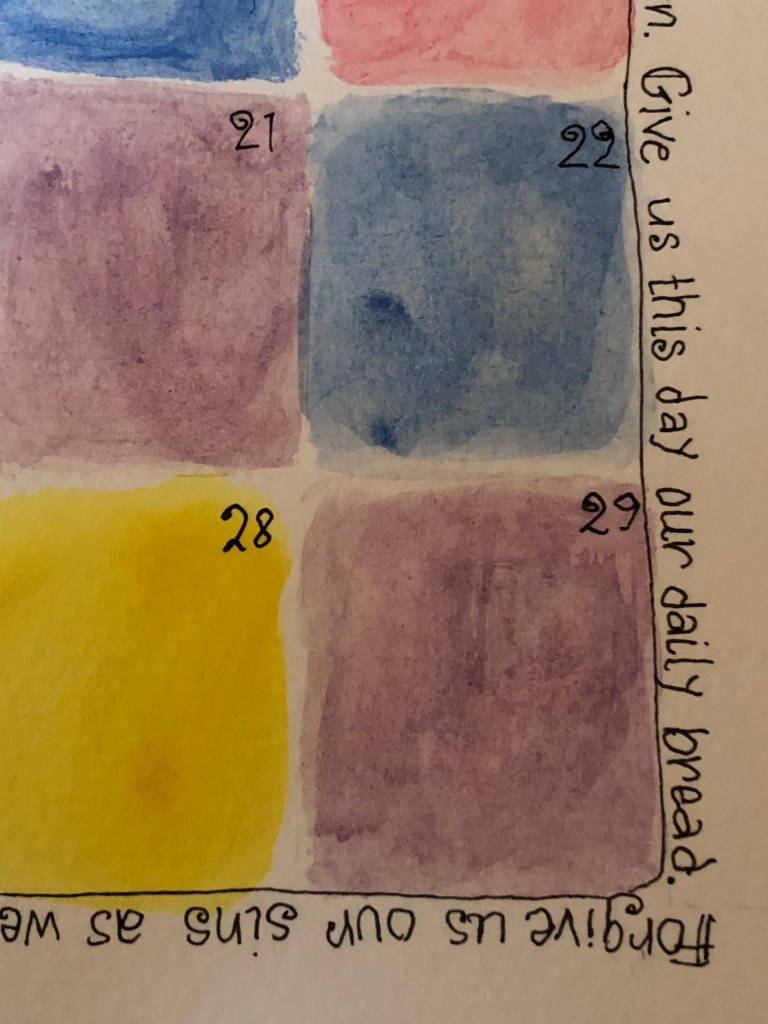
I’ve given you (or you will get it in the mail soon) a Lent calendar for your use each day. Record your experience of renewal. It may be a new way of praying, something you heard from God that meets your current need, a Bible verse that specifically means something TODAY, or something someone said that resonates with you. Meet each day of Lent with the expectation that God wants to communicate with you.
Behold, I stand at the door and knock. If anyone hears my voice and opens the door, I will come in to him and eat with him, and he with me. Revelation 3:10





Leave a comment