Tag: Deeply Rooted Lord’s Prayer Study

  • Thy will be done on earth as it is in heaven.

    Prayer of Relinquishment

    The dictionary definition of relinquishment is to give up, to abandon.   When I think of giving up and letting go I think of a tug of war battle.  Each team leans away from the other believing in it’s own strength, sweating it out until one team falters and can’t hang on.  One team gives up and abandons the game.  It is important that sometimes when we sit down with our Father, we too, give up.

    Palms down.

    In early March 2020, I felt that I had everything in control.  I was pleased with my life.

    COVID hit me hard.  Growing up relatively poor taught me to live with little, so I missed some of the angst.  But.  Much of what I relinquished during COVID was what had given my life meaning.  Two weeks after shutdown I was to have spent a week at outdoor school with my sixth grade class.  Normally it would be the highlight of my year.  Instead, for two years, without notice, I administered poorly written online courses and begged students to show up on their computers.

    Once we were able to leave our homes this is a list of what I did outside of our home from March 2020 – April 2021:

    Bank: 1

    Dollar Store: 3

    Plant Nursery: 3

    Friend 1: 1

    Friend 2: 20

    Friend 3: 4

    Specialty Store: 5

    Place of Employment/School: 11

    Hair Stylist: 3

    Massage:  6

    Library:  8

    Safeway: 3

    Cutsforth’s grocery store:  once a week

    Hotel visits: 2

    Clenched fists.

    By April 2021 I felt that I’d relinquished enough.  No teaching in a real classroom.  No visits to relatives.  No in person church. No worship leading with my friends. No restaurants. No Portland. Even walking down the street in Canby was different.  I’d walk across the street if I was to meet anyone on the sidewalk. 

    On the other hand, I’d only lost one dear one. Many people lost their livelihoods. I’m somewhat embarrassed to put it out there that I felt loss during COVID. I’d escaped without even experiencing COVID itself. BUT my life changed.  I thought that growing up relatively poor was my big lesson in life. It wasn’t.

    Giving up life experiences during COVID helped me understand what relinquishment means.  It is heart wrenching.  It is leaving dreams behind.  It means not being in control.  It means expectations be dashed.  Which means that I may or may not be prepared to relinquish anything ever again. Have I shut down after COVID?  Do I no longer trust God because He let COVID happen? Do I ignore the need for relinquishment because I’ve had enough?

    True relinquishment takes us to the garden of Gethsemane. “Not my will but yours be done,” Jesus taught us.  God’s choice.  But before God’s decision, it was Christ’s. Christ made the choice to relinquish His right to life and be crucified.  We can’t possibly understand all that Jesus gave up while in the garden.  We suppose He was facing grisly death.  We suppose that He was torn in two with the knowledge that, in death, He would be separated from His Father. He may have also been thinking about leaving his relatives and friends.  He may have been fearful of the loss of control. He may have been thinking about some of the things we leave behind when we mourn.

    Jesus was able to trust God during difficult times because He spent much of His the rest of His time worshiping and listening for His Father’s voice. Christ was sure of His Father’s devotion to Him. Jesus was sure of His (and our) future, though sweating blood because of what He’d have to experience in His near future.

     And let us run with perseverance the race marked out for us, fixing our eyes on Jesus, the pioneer and perfecter of faith. For the joy set before him he endured the cross, scorning its shame, and sat down at the right hand of the throne of God. Ephesians 12:1b-2

    If Jesus experienced all sin (2 Corinthians 5:21) before He beat it, He goes before us, understanding both the good and bad things that we’d rather not give up.

     For we do not have a high priest who is unable to empathize with our weaknesses, but we have one who has been tempted in every way, just as we are—yet he did not sin.  Let us then approach God’s throne of grace with confidence, so that we may receive mercy and find grace to help us in our time of need. Hebrews 4:15-16

    Richard J. Foster describes the prayer of relinquishment:

    Struggle is important because the prayer of relinquishment is Christian prayer and not fatalism. We do not resign ourselves to fate. We are not locked into a pre-set, determinist future. Ours is an open, not a closed, universe. We are  “co-laborers with God” as the Apostle Paul put it – working with God to determine the outcome of events. Therefore our prayer efforts are a genuine give and take, a true dialogue with God. And relinquishment is our full and wholehearted agreement with God that his way is altogether right and good.

    The Prayer of Relinquishment is letting go, a release with hope, a confident trust in the character of God. Even when all we are able to see is the tangled threads on the backside of life’s tapestry, we know that God is good and is out to do us good always. And that gives us hope to believe that we are the winners regardless of what we are being called upon to relinquish. God is inviting us deeper in and higher up. There is training in righteousness, transforming power, new joys, deeper intimacy. Besides, often we hold so tightly to the good that we do know that we cannot receive the greater good that we do not know. And God has to help us let go of our tiny vision in order to release the greater reality he has in store for us.

    Assignment:

    Where are you struggling?  What are you worried about? How have your prayers been left unanswered?  Is there something that you need to relinquish?  Here is this week’s assignment> 

    Palms Up, Palms Down*

    Sit in a comfortable position.

    Invite the presence of God.

    Palms down

    Place your palms on your legs facing down:  symbolic that you are giving your requests to God. 

    Name your worries or anxieties.

    Imagine yourself releasing them to God. You may picture the hands of the Father’s hands receiving. 

    Pray:  Not my will, but Thine be done.

    Listen.

    Palms Up 

    Turn your hands palms up. Ask Jesus for His peace, courage, presence, love or a plan of action. 

    Notice the quiet. Rest. Receive peace and power in the presence of God. Receive a particular promise from scripture. Accept reassurance, clarity, direction.  

    Believe in God’s active and powerful love in you and allow His presence to be more than enough.

    *Palms Up, Palms Down:  The Prayer Course.  https://downloads.24-7prayer.com/prayer_course/2019/resources/pdfs/9%20Palms%20Up,%20Palms%20Down.pdf

    Perspective:  Growing Edges, Richard J. Foster, https://renovare.org/articles/the-prayer-of-relinquishment
  • New Every Morning


    The steadfast love of the Lord never ceases; His mercies never come to an end; they are new every morning; great is your faithfulness. “The LORD is my portion,” says my soul, “therefore I will hope in Him.”  Lamentations 3:22-24

    While I was growing up, my father was a pastor, which made for some interesting conversations.  Once after a revival pastor left town, I got up the nerve to ask my father something that, looking back on it, I should have phrased better, “Dad, everybody says the speaker we had in church is a better speaker than you.  Why is that?”  My father firmly informed me that revivalists recycle their sermons to perfection by preaching them multiple times.  It is a church pastor’s aim to hear what God is saying on a specific Sunday to a very specific audience.

    I had a similar experience later in life.  The church where I was going hired a very special speaker for a women’s retreat.  As a college student I’d heard this woman speak and was moved to buy her books.  I greatly admired her way of life.  As she spoke during the retreat, I realized the her heartfelt words were the same as they were twenty years before.  

    Both experiences helped me realize that my relationship with God can go stale if I don’t expect it to improve daily.  His steadfast love for me is never-ending.  It is current, up-to-date every morning.  I want to experience that type of love, and respond likewise.

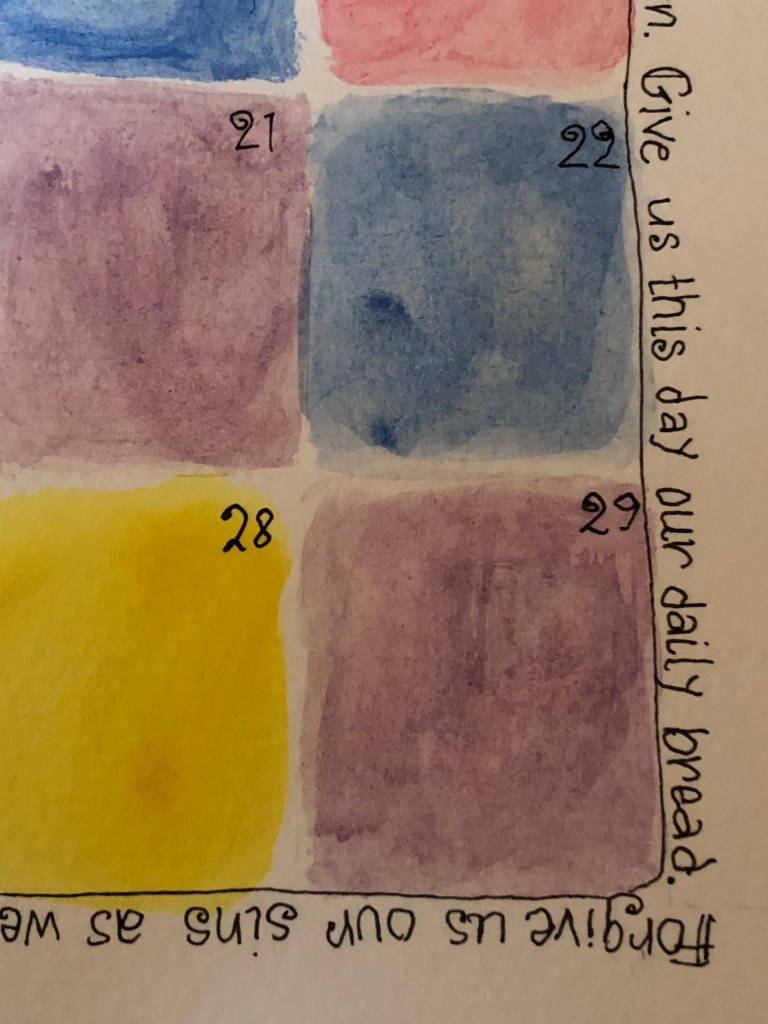
    I’ve given you (or you will get it in the mail soon) a Lent calendar for your use each day. Record your experience of renewal.  It may be a new way of praying, something you heard from God that meets your current need, a Bible verse that specifically means something TODAY, or something someone said that resonates with you.  Meet each day of Lent with the expectation that God wants to communicate with you.


    Behold, I stand at the door and knock. If anyone hears my voice and opens the door, I will come in to him and eat with him, and he with me.  Revelation 3:10

  • Starting Out

    A Lent Adventure

    “As you listen to birds calling to one another, hear also My love-call to you.  I speak to you continually:  through sights, sounds, thoughts, impressions, scriptures.  There is no limit to the variety of ways I can communicate with you.”  Sarah Young, “God Calling”. 

    One morning while listening to the birds outside my window, I glanced down to my devotional page, and read Young’s thoughts. I was amazed at the “coincidence”. The variety of birdsong outside my window often amazes and sometimes annoys me. I find the sound of mourning doves especially obnoxious, which made me wonder: Do I sometimes find God’s love call equally uncomfortable?

    A psalmist describes God’s limitless love:

    “Your love, Lord, reaches to the heavens, Your faithfulness to the skies. Your righteousness is like the highest mountains, Your justice like the great deep.” Psalm 36:5-6.

    Do I allow that kind of love to reach me? Or do I willingly sabotage God’s advances by ignoring or putting a limit on what He is trying to show me.  Am I available to Him?  How do I actively limit God’s limitless speech? 

    After all, I’ve been a Christ-follower for fifty years. I should be good at communing with God..  I’ve had plenty of time to practice.  I’m worship leader for my church. I have a daily prayer time which includes Lectio 365. I take seriously my job to allow God to make me a better me… all the time.  I retreat.  I read.  I facilitate events.  I pray with others.

    But. Am I willing to stop to listen. Am I willing to slow down to hear God’s thoughts and express my own thoughts to Him?  Not usually.  Normally sometime during the day I pray for my family and friends, praying especially for those who are in crisis.  But.  Am I willing to stop?  Listen?  React to what I hear?

    Christ, the Son of God, often spent time with His Father; notably in the wilderness before the start of His ministry and in the garden before His ministry’s completion.  The gospel of Luke mentions Jesus praying 26 times, also mentioning that Jesus often stepped away from His disciples to spend time with His Father.  Jesus’ mission on earth was to fulfill the wishes of His Father.  He understood the necessity of  prayer in order to receive instructions before His busily went about doing His Father’s will.

    Christ’s disciples understood how much time and effort Christ put into His link with God. One of them was jealous enough of this time to ask Jesus to share His thoughts on how to talk with the Father.  Jesus’ words, known as the “Our Father” and “The Lord’s Prayer” are passed down to us in the bible, a central part of Christian worship.

    If you are my age the LORD’s prayer may have been the third prayer you memorized as a child, after “God, is good, God is great …” and  “Now I lay me down to sleep.”  Though many of us recite the prayer more often in church than at home, Christ carefully outlined it’s use. Before He spoke it to His disciples, He said,

    But when you pray, go into your room, close the door and pray to your Father, who is unseen. Then your Father, who sees what is done in secret, will reward you. 

    The prayer is to be an act of devotion: private and rewarding, used as a template for deeper communication between God and us.  

    When Jesus said, ‘This then is how you should pray,’ He asked his disciples to utilize the prayer more as a guide than a destination, a template for further thoughts and conversation with God.

    Our Father, Who art in heaven is a prompt to pause, acknowledge God, and let go of thoughts which may prayer.

    Hallowed be your name is an invitation focus deeply on God’s character, acknowledging His majesty.

    Thy Kingdom come, Thy will be done, on earth as it is in heaven is an opportunity hear God’s will and to align our will with His.

    Give us this day our daily bread invites us to pray about our most practical needs and for the needs of others. 

    Forgive us our sins is a challenge to name the ways in which we have sinned in order to receive forgiveness.

    As we forgive those who sin against us reminds us to acknowledge that we’ve been hurt, pray for the desire to reconcile with those who have hurt us, and ask for the determination to make things right.

    And lead us not into temptation, but deliver us from evil,  a call to acknowledge our temptations and allow God to make us aware of spiritual warfare happening around us.

    For Thine is the kingdom and the power and the glory forever reminds us that God is in control and has the power over the world.  It nudges us to continue praying unanswered prayers.

    Amen  

    Praying through the Lord’s Prayer in this way allows us to embark upon personal adventures of adoration, petition, intercession, confession and spiritual warfare. 

    Martin Luther articulates it this way, 

    “To this day I am still nursing myself on the Lord’s Prayer like a child, and am still eating and drinking of it like an old man without getting bored of it.” 

    I encourage you, along with me, to “eat and drink” on the Lord’s Prayer during this Lent season. Let’s look at the Our Father phrase by phrase, and thereby increasing it’s power in our lives.  We’ll find ourselves connecting directly with God, enjoying times of worship, relinquishment, repentance and forgiveness.

    Assignment:
    Other than in the Bible, the earliest mention of praying the Lord’s Prayer is in the Didache, written between 70 AD-90 AD; also around the time the gospels were written.  After reading claims of which was written first (the gospels or the Didache), which quotes which, etc., my head spins. That is a side note. 

    It is suggested in the Didache that Christians pray the Lord’s Prayer three times daily.  Our first assignment is to attempt praying the prayer the way the earliest Christians prayed it: three times daily.  A current world suggestion:  Set an alarm for your mid-day prayer time!