Tag: The Lord’s Prayer

  • Lead us not into temptation. 

    Discernment 

    The word of God is living and active, sharper than any two-edged sword, piercing to the division of soul and of spirit, of joints and of marrow, and discerning the thoughts and intentions of the heart.  Hebrews 4:12

    Lead us not into temptation.  A conundrum.  Why does Jesus ask that we not be led to temptation?  The implication is that God can lead our way toward temptation, but we need to request that He doesn’t.  Doesn’t God want to lead us away from temptation?

    The source of temptation is not God. (James 1:13-15) In Prayer: Finding the Heart’s True Home.  Foster writes of the negative (lead us not to temptation) and positive (but deliver us from evil):  “The first part of the petition has disturbed many.(Ha, ha!  We aren’t the only ones who’ve sensed a Rae Knopp conundrum here!)  How can God, our redeemer, both lead us into temptation and shield us from temptation? “The Greek word (temptation) itself means “trials” or “trying circumstances,”  Foster goes on to write “the only time God tries us is when there is something in our hearts that needs revealing. For example, Judas was a man who had difficulty with money, which was precisely why Jesus made him the treasurer of the apostolic band. In time, what was in the heart of Judas came to light.”  Jesus lead Judas into a situation where his love of money would be stronger than his love for Christ.

    “Satan tempts us that he may bring out all the evil that is in our hearts; God tests us that He may bring out all the good.” F.B. Meyer

    While I was in high school. I went on a school biology trip to the Steens Mountains.  It was an overnight camping trip in late fall.  Quite cold.  A group of hunters camping next to our campsite, welcomed some of us over to their campfire.  We felt a little weird about joining the group of older men, but did it anyway.  After a while our conversation got to religion.  One of the men looked me straight in the eye, and said, “Do you believe in God?”  

    I felt my blood run cold.  I, of course, more than believed in God.  I loved God.  I had a very personal relationship with God.  I looked around the campfire, catching the eyes of several of my classmates.

    Peter, at a similar fire, had a similar decision to make.  How would he react to being called a Christ follower?  He had just told Jesus that he was prepared to go to prison and die for him.  “This man was also with him.”  Peter had a split second to answer the servant girl.  Peter denied even knowing Christ. 

    Christ had foretold Peter’s denial saying:  “Simon, Simon, behold Satan has demanded to sift all of you* like wheat, but I have prayed that your own faith may not fail; and once you have turned back, you must strengthen your brothers.”   Luke 22:31-32 

    The temptation to downplay my relationship with Christ was strong in me.  My answer to the hunter was similar to Peter’s to the servant girl.  “Of course I believe in God.  My Dad is a pastor.” Immediately I was deeply disturbed by my response to the question.  I had succumbed to the temptation to deny Christ’s importance to me.

    At the time, my denial strengthened my faith in God. Years later, I passed on to my children what I learned during the fireside conversation.  I stressed that their decisions to follow Jesus are personal commitments that are on-going.  

    Dealing with temptation and our dark side.  

    At the campfire, I was very aware that I was being tempted.  At the time, I thought it was by Satan.  Now I wonder if I needed to know how easy it would be for me to deny Christ.  How can we battle Satan and our own tendency to sin?  Our protection is in Ephesians 6:10-20:  Truth, righteousness, peace, faith, salvation, the word of God.  The armor of God. When we find ourselves in a negative, hurtful tempting situation, how should we pray?

    Truth:  What is true?  What is a lie?  What might destroy us or others?  What would Jesus do?

    Righteousness:  Jesus has our backs.  We NEVER have to lean on our own righteousness. Don’t listen to the voice of condemnation.  It’s not from God.

    Peace:  Are you at peace?  If not, the Jesus prayer may be of service:  “Lord, Jesus, have mercy on me a sinner.”  Pray it for other people as well.

    Faith:  In whom or what are you is your faith?  Are leaning on the everlasting arms, or something else or someone else?  Idols?  Hmmmmmm.  

    Salvation:  Our salvation is in Christ alone.  We can count on it.  Nothing else is certain.

    The Word of God:  What does the bible say about our situation?  Be quiet and listen.  2 Corinthians 3:16-18  God will provide you with His Word, especially when you ask.  He’s not into a guessing game.  God wants to give you His Word through the bible, the Holy Spirit or others. Hebrews 4:12-16

    A couple more things:

    1. Be aware the devil is out to kill, steal, and destroy. (2 Corinthians 2:11).  If something seems not quite right, it probably isn’t.  Go to God.  He is our spiritual authority.  Don’t doubt what you are discerning. We can easily underestimate what is going on in the spiritual world.

    2)   Be aware of your weakness. (2 Corinthians 12:9).  God can use your weaknesses.  It is important to acknowledge that you are weak and work with God.  God redeems.  He’s done it over and over: Joseph:  Genesis 50:15-20,  Israel:  Jeremiah 24,  Peter:  Luke 22:54-62 / John 21:15–17.

    3)  Again, remember, when tempted or tested, God has made a way of escape. God is a good, good Father, who wants the best for us. 1 Corinthians 10:1-13

    4)  Be vulnerable. (James 5:16).  God’s grace is strengthened in a community. Ecclesiastes 4:12.  The idea of a one cord rope versus a three is very concrete.  Remember:  We are stronger TOGETHER.

    Foster, Richard J. Prayer: Finding the Heart’s True Home, p.188 & 189.
  • Give us This Day, our Daily Bread.

    Petitionary Prayer for the World

    Let all the earth fear the Lord;
        let all the people of the world revere him.

    For he spoke, and it came to be;
        he commanded, and it stood firm.

    The Lord foils the plans of the nations;
        he thwarts the purposes of the peoples.

    But the plans of the Lord stand firm forever,
        the purposes of His heart through all generations.

    Psalm 33:8-11

    Last week we prayed that we would allow God to make his kingdom in ourselves.  This week we pray that God’s kingdom come, and be done in the world as it is in heaven.

    If you are like me, most days I pray for myself, my family, and my most immediate concerns but have not consistently widened the scope of my prayers to include folks I’ve never met.  Therefore, it may be especially straightforward this week to reach Gretchen’s goals for increased expectation, capacity and perception.  At the moment, I start at near ground zero.  I don’t often pray for people outside what I consider my sphere of influence.  Should the range of my prayer influence widen?

    Last October, I was in dark, rainy Oxford, UK. I’d been wet and uncomfortable all day and had a cold.  I didn’t have enough clothing to keep warm.   It was evening. There were lots of people in the street and the rain wasn’t going to stop.  I glanced to my left and spotted a woman close by who reminded me of myself.  As our eyes met, she asked me for money.  At that moment I was overcome with emotion, mainly sadness. I felt a connection between her and I.  I looked into her eyes, she registered a look of surprise.  I realized that my eyes mirrored the sorrow I was feeling.  The lady took several steps backward, muttering, “No! No!” and disappeared into the crowd.   I walked on, shaken.  I had no idea why she’d reacted to me with fear.  I decided that I owed this woman.  I committed myself to pray for her.

    Since the early days of Christendom, people have made it their vocation to step away from everyday life to fully devote themselves to prayer.  Bells ring in communities around the world calling women and men to prayer several times daily.  Joining monastics are everyday people who connect with prayer movements such as Prayer 24-7.  As a young mother, I prayed with several women, who spent more time in prayer than I did.  We called these women our prayer warriors. 

    From  MaryKate Morse:

    We, too, are called to pray for the world.  “Today believers are priests who are the bridge-builders in their neighborhoods.  … Out of the security of our love in God, we pray for others without any thought of gain.  Blessing prayers are priestly prayers. …Priestly prayers are prayed generously and with lovingkindness for the nations of the world by all of us.  

    We’ve the grace and opportunity to participate in what God is doing.  He desires that we join Him in His work in the world.  With the habit of praying for some of the world’s needs each day, comes an increased perspective of how huge God’s love is.  We also more fully understand our place in the world and may realize more responsibility for the well being of others. 

    When praying for others:

    1. Ask God for increased perspective.  For example, be watchful for specific ways to pray while driving around town.  God will make needs known to you.  Actively listen for ways to pray while watching the world news. Ask God for discernment.  Put yourself in the shoes of whom you are praying.
    2. Ask God for increased capacity.  Pray that you will not be overwhelmed.  There is tremendous need.

    Start small.

    Put limits on news and socials that leave you defeated.

    Look for stories on progress God is making in the world.  Share the stories with others.

    Remember God is in control.

    3.  Ask for increased expectation.  

    Now to him who is able to do immeasurably more than all we ask or imagine, according to his power that is at work within us,to him be glory in the church and in Christ Jesus throughout all generations, forever and ever! Amen.  Ephesians 3:20&21

    It may be helpful for you to choose one specific area to pray for.  Here is a list of possible international prayer topics:

    1. Healing
    2. The hungry
    3. Peace
    4. Unreached people groups
    5. The poor and under-served
    6. Climate change and the environment
    7. Areas of injustice
    8. Use of scientific advancement
    9. Oppression of LBTQIA+ folks and their community
    10. The government
    11. Care of refugees and immigrants
    12. The enslaved
    13. The church 
    14. Guidance through changes


    Here are some tools that may help you settle on a way to expand your prayer life:

    Operation World:  https://operationworld.org/
    An app for your phone. Operation World highlights a country for prayer each day. includes basic information.

    The World Fact-book: https://www.cia.gov/the-world-factbook/ Information which sparks prayer for specific countries.

    The Joshua Project: https://www.joshuaproject.net/ Started in 1995, this group seeks to provide information on people groups with the least access to information about Jesus.

    24-7 Prayer https://www.24-7prayer.com/ A worldwide prayer movement for nonstop prayer with the aim of church revival.  Lectio 365 is it’s devotional resource.

    Source:

    Morse, MaryKate, A Guidebook to Prayer: Twenty-four ways to Walk with God, pgs. 66-73. Practical book on how to pray.  I have a copy that you may borrow.

  • Thy will be done on earth as it is in heaven.

    Prayer of Relinquishment

    The dictionary definition of relinquishment is to give up, to abandon.   When I think of giving up and letting go I think of a tug of war battle.  Each team leans away from the other believing in it’s own strength, sweating it out until one team falters and can’t hang on.  One team gives up and abandons the game.  It is important that sometimes when we sit down with our Father, we too, give up.

    Palms down.

    In early March 2020, I felt that I had everything in control.  I was pleased with my life.

    COVID hit me hard.  Growing up relatively poor taught me to live with little, so I missed some of the angst.  But.  Much of what I relinquished during COVID was what had given my life meaning.  Two weeks after shutdown I was to have spent a week at outdoor school with my sixth grade class.  Normally it would be the highlight of my year.  Instead, for two years, without notice, I administered poorly written online courses and begged students to show up on their computers.

    Once we were able to leave our homes this is a list of what I did outside of our home from March 2020 – April 2021:

    Bank: 1

    Dollar Store: 3

    Plant Nursery: 3

    Friend 1: 1

    Friend 2: 20

    Friend 3: 4

    Specialty Store: 5

    Place of Employment/School: 11

    Hair Stylist: 3

    Massage:  6

    Library:  8

    Safeway: 3

    Cutsforth’s grocery store:  once a week

    Hotel visits: 2

    Clenched fists.

    By April 2021 I felt that I’d relinquished enough.  No teaching in a real classroom.  No visits to relatives.  No in person church. No worship leading with my friends. No restaurants. No Portland. Even walking down the street in Canby was different.  I’d walk across the street if I was to meet anyone on the sidewalk. 

    On the other hand, I’d only lost one dear one. Many people lost their livelihoods. I’m somewhat embarrassed to put it out there that I felt loss during COVID. I’d escaped without even experiencing COVID itself. BUT my life changed.  I thought that growing up relatively poor was my big lesson in life. It wasn’t.

    Giving up life experiences during COVID helped me understand what relinquishment means.  It is heart wrenching.  It is leaving dreams behind.  It means not being in control.  It means expectations be dashed.  Which means that I may or may not be prepared to relinquish anything ever again. Have I shut down after COVID?  Do I no longer trust God because He let COVID happen? Do I ignore the need for relinquishment because I’ve had enough?

    True relinquishment takes us to the garden of Gethsemane. “Not my will but yours be done,” Jesus taught us.  God’s choice.  But before God’s decision, it was Christ’s. Christ made the choice to relinquish His right to life and be crucified.  We can’t possibly understand all that Jesus gave up while in the garden.  We suppose He was facing grisly death.  We suppose that He was torn in two with the knowledge that, in death, He would be separated from His Father. He may have also been thinking about leaving his relatives and friends.  He may have been fearful of the loss of control. He may have been thinking about some of the things we leave behind when we mourn.

    Jesus was able to trust God during difficult times because He spent much of His the rest of His time worshiping and listening for His Father’s voice. Christ was sure of His Father’s devotion to Him. Jesus was sure of His (and our) future, though sweating blood because of what He’d have to experience in His near future.

     And let us run with perseverance the race marked out for us, fixing our eyes on Jesus, the pioneer and perfecter of faith. For the joy set before him he endured the cross, scorning its shame, and sat down at the right hand of the throne of God. Ephesians 12:1b-2

    If Jesus experienced all sin (2 Corinthians 5:21) before He beat it, He goes before us, understanding both the good and bad things that we’d rather not give up.

     For we do not have a high priest who is unable to empathize with our weaknesses, but we have one who has been tempted in every way, just as we are—yet he did not sin.  Let us then approach God’s throne of grace with confidence, so that we may receive mercy and find grace to help us in our time of need. Hebrews 4:15-16

    Richard J. Foster describes the prayer of relinquishment:

    Struggle is important because the prayer of relinquishment is Christian prayer and not fatalism. We do not resign ourselves to fate. We are not locked into a pre-set, determinist future. Ours is an open, not a closed, universe. We are  “co-laborers with God” as the Apostle Paul put it – working with God to determine the outcome of events. Therefore our prayer efforts are a genuine give and take, a true dialogue with God. And relinquishment is our full and wholehearted agreement with God that his way is altogether right and good.

    The Prayer of Relinquishment is letting go, a release with hope, a confident trust in the character of God. Even when all we are able to see is the tangled threads on the backside of life’s tapestry, we know that God is good and is out to do us good always. And that gives us hope to believe that we are the winners regardless of what we are being called upon to relinquish. God is inviting us deeper in and higher up. There is training in righteousness, transforming power, new joys, deeper intimacy. Besides, often we hold so tightly to the good that we do know that we cannot receive the greater good that we do not know. And God has to help us let go of our tiny vision in order to release the greater reality he has in store for us.

    Assignment:

    Where are you struggling?  What are you worried about? How have your prayers been left unanswered?  Is there something that you need to relinquish?  Here is this week’s assignment> 

    Palms Up, Palms Down*

    Sit in a comfortable position.

    Invite the presence of God.

    Palms down

    Place your palms on your legs facing down:  symbolic that you are giving your requests to God. 

    Name your worries or anxieties.

    Imagine yourself releasing them to God. You may picture the hands of the Father’s hands receiving. 

    Pray:  Not my will, but Thine be done.

    Listen.

    Palms Up 

    Turn your hands palms up. Ask Jesus for His peace, courage, presence, love or a plan of action. 

    Notice the quiet. Rest. Receive peace and power in the presence of God. Receive a particular promise from scripture. Accept reassurance, clarity, direction.  

    Believe in God’s active and powerful love in you and allow His presence to be more than enough.

    *Palms Up, Palms Down:  The Prayer Course.  https://downloads.24-7prayer.com/prayer_course/2019/resources/pdfs/9%20Palms%20Up,%20Palms%20Down.pdf

    Perspective:  Growing Edges, Richard J. Foster, https://renovare.org/articles/the-prayer-of-relinquishment

  • I will do something new


    Behold, I will do a new thing. Now it shall spring forth;  Shall you not know it?  I will even make a road in the wilderness And rivers in the desert.  Isaiah 43:19


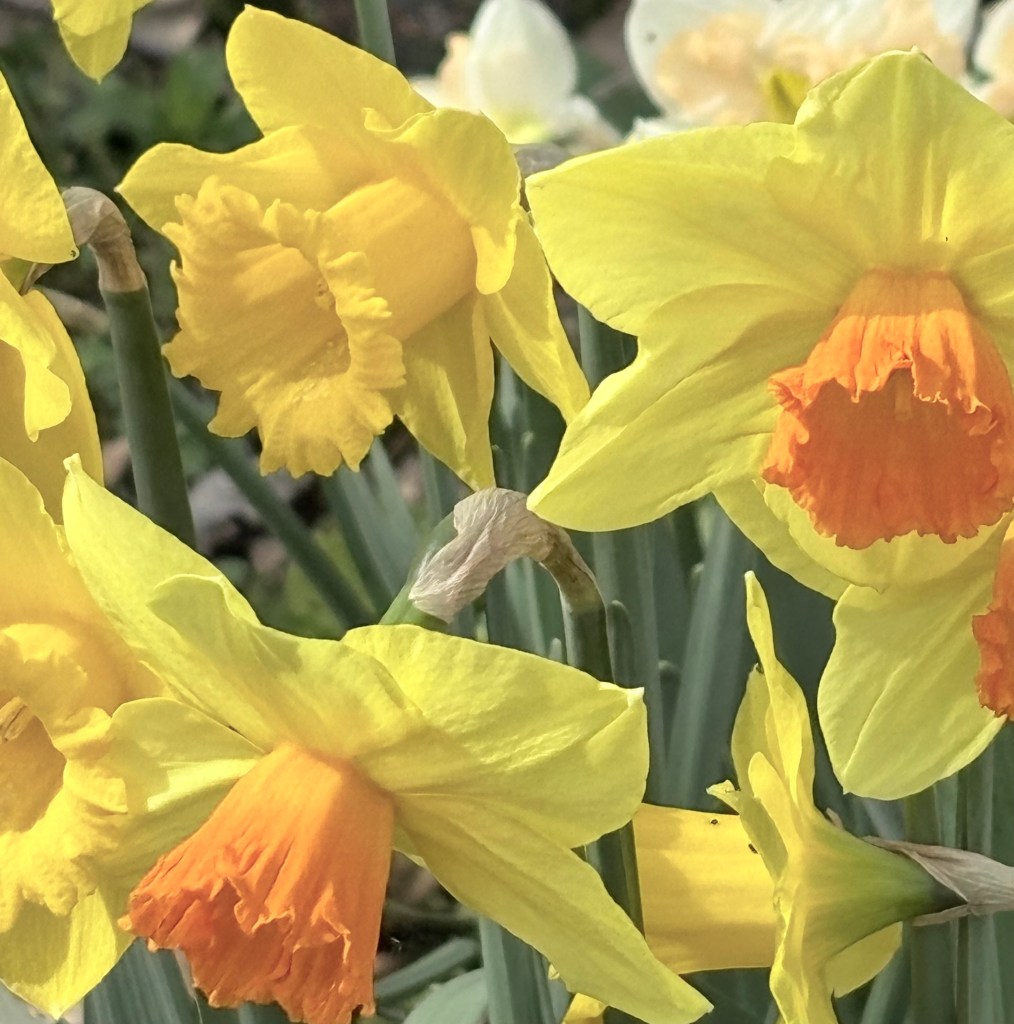
    Sunshine in spring is especially glorious here in the Oregon’s Willamette Valley, especially when it comes after weeks and weeks of rain and cold weather.  Greens are greener and the daffodils’ yellow defies imagination.  The Lenten roses, with their intricate, delicate detail are magical.  The ground is clean and new.  The dirt is especially primed for the rains that will inevitably fall for the next few months.  The earth is like a sponge in the spring.


    Sow righteousness for yourselves, reap the fruit of unfailing love, and break up your unplowed ground; for it is time to seek the LORD, until he comes and showers his righteousness on you.  Hosea 10:12

    In order to get the best yield of crops, before planting the ground is plowed.  Soft soil ensures that water will trickle down to reach seeds and plant roots.   On the other hand, if the same soil is completely dry, water may bounce off it and not reach the plant where it is needed.  Similarly, when our hearts are soft and ready for prayer, it is possible to soak in God’s goodness.  Soft hearts are thirsty hearts.  

    How did Christ prepare His heart before praying the Lord’s Prayer?  First, He acknowledged God.  The need to slow down to recognize God before praying should be intuitive:  when we first see someone we know, we automatically greet them.  Yet we tend to pray the way we spend our busy lives: purpose driven.  We go to prayer for a specific purpose.  Prayers can be driven by the need to get in, get out and get back to real life.  Is that type of prayer as effective as sprinkling water on dry ground?  God listens, but are our hearts soft enough for God’s thoughts to penetrate us?  During Lent, let’s grant ourselves the luxury of quieting our minds and hearts before praying. Let’s make our hearts ready to see and hear God.  See Matthew 13:10-18.

    The Practice of Centering

    Here are a few ways to slow down in order to limit distractions and facilitate more intimacy with God.  Try several to find what works for you.  Are there methods not on this list?  Please share them with the group via What’s App or in the comments below.

    Breath Prayer

      1.  Breath slowly until you feel your body relaxing. 

    2.  Inhaling the Spirit of God, exhaling your cares and worries.

    3.  Find a word, such as “trust”  or “Jesus” to repeat as you sit quietly, and your mind begins to wander.

    4.  Repeat a short verse, actively listen for what God may be saying through the verse.  Example verses:

    Like clay in the hand of the potter, so are you in my hand.  Jeremiah 18:6

    My presence will go with you, and I will give you rest.  Exodus 33:14

    The Jesus Prayer. A historic prayer used especially by Catholic and Orthodox believers.

    Lord Jesus Christ, Son of God, have mercy on me a sinner.

    Physical aids to center in prayer:

    A Prayer Shawl

    Light a Candle

    Reserve a location for prayer at home.

    Focus on the outdoors.

    Prayer beads.

    A change in posture.

    Worship in Prayer

    The second thing Christ did in The Lord’s Prayer was to worship His Father.

    There are 950 names and descriptions of God in the Old Testament.  Only 15 OT verses name God as Israel’s Father/husband.  In Christ’s day, the idea of God the Father would have been unexpected and therefore, the disciples may have thought it strange when Christ started His prayer with “Our Father.”

    Today it is significant when we enter prayer recognizing God for who He is.  Rather than praying only for what He can do for us, it is a special treat to slow down to tell our Father how much we love Him.  When we STOP to deepen our thoughts with all that God is, we realize our place, our need for Him. It is then possible to relax in the knowledge that God is our Father, we are His children.  He is listening.  While we are are grass (Psalm 103:15) and dust (Psalm 103:14-16), He is the beginning and the end (Rev. 21:6), a rock, fortress, and deliverer (Psalm 18:2).

    In Hebrews 13:15 it is written, “Through Him then let us continually offer up a sacrifice of praise to God, that is, the fruit of lips that acknowledges His name.”  Praise is often a sacrifice.  It is an act of the will.  Lack of time, energy, space, lethargy, to do lists, distraction, depression, disappointment, busyness, fear, etc. interfere.  When we make a practice of slowing down to acknowledge God as our Father before we pray, we are more likely to offer our lives as a continual sacrifice of praise.

    The Practice of Worship in Prayer

    After slowing your mind (and maybe your body), remember to honor God first. Here are some ways to worship God as your Father during prayer:

    1. Repeat names and characteristics of God.

    2. Pray the Psalms.

    3. Take a walk, praising God for His creation: “The heavens declare the glory of God” (Psalm 19:1, KJV).

    4. Pray liturgical prayers, see below.

    5. Sing or listen to hymns and choruses.

    6. Slowly sing the Doxology several times.

    7. Repeat phrases:

    I trust you, Father.

    Father, Your will be done.

    8.  Repeat verses such as these:

    Do we not all have one Father? Did not one God create us?  Malachi 2:10

    You are my Father. I am the clay, You are the potter.  I am the work of Your hand.  Isaiah 64:8

    You are one God and Father of all, who is over all, and through all, and in all. Ephesians 4:6

    Worshiping God gives us the opportunity to get to know Him better.  Prayer is strongest when it is selfless: a remembrance of the character and ways of the God we are beginning to know and love.

    References:

    Christian Prayer: The Liturgy of the Hours

    Greig, Pete, How to pray: a simple guide for normal people

    Morse, MaryKate, A Guidebook to Prayer

    Toolshed Index of Thirty Prayer Tools,  http://www.prayercourse. org

  • New Every Morning


    The steadfast love of the Lord never ceases; His mercies never come to an end; they are new every morning; great is your faithfulness. “The LORD is my portion,” says my soul, “therefore I will hope in Him.”  Lamentations 3:22-24

    While I was growing up, my father was a pastor, which made for some interesting conversations.  Once after a revival pastor left town, I got up the nerve to ask my father something that, looking back on it, I should have phrased better, “Dad, everybody says the speaker we had in church is a better speaker than you.  Why is that?”  My father firmly informed me that revivalists recycle their sermons to perfection by preaching them multiple times.  It is a church pastor’s aim to hear what God is saying on a specific Sunday to a very specific audience.

    I had a similar experience later in life.  The church where I was going hired a very special speaker for a women’s retreat.  As a college student I’d heard this woman speak and was moved to buy her books.  I greatly admired her way of life.  As she spoke during the retreat, I realized the her heartfelt words were the same as they were twenty years before.  

    Both experiences helped me realize that my relationship with God can go stale if I don’t expect it to improve daily.  His steadfast love for me is never-ending.  It is current, up-to-date every morning.  I want to experience that type of love, and respond likewise.

    I’ve given you (or you will get it in the mail soon) a Lent calendar for your use each day. Record your experience of renewal.  It may be a new way of praying, something you heard from God that meets your current need, a Bible verse that specifically means something TODAY, or something someone said that resonates with you.  Meet each day of Lent with the expectation that God wants to communicate with you.


    Behold, I stand at the door and knock. If anyone hears my voice and opens the door, I will come in to him and eat with him, and he with me.  Revelation 3:10

  • Starting Out

    A Lent Adventure

    “As you listen to birds calling to one another, hear also My love-call to you.  I speak to you continually:  through sights, sounds, thoughts, impressions, scriptures.  There is no limit to the variety of ways I can communicate with you.”  Sarah Young, “God Calling”. 

    One morning while listening to the birds outside my window, I glanced down to my devotional page, and read Young’s thoughts. I was amazed at the “coincidence”. The variety of birdsong outside my window often amazes and sometimes annoys me. I find the sound of mourning doves especially obnoxious, which made me wonder: Do I sometimes find God’s love call equally uncomfortable?

    A psalmist describes God’s limitless love:

    “Your love, Lord, reaches to the heavens, Your faithfulness to the skies. Your righteousness is like the highest mountains, Your justice like the great deep.” Psalm 36:5-6.

    Do I allow that kind of love to reach me? Or do I willingly sabotage God’s advances by ignoring or putting a limit on what He is trying to show me.  Am I available to Him?  How do I actively limit God’s limitless speech? 

    After all, I’ve been a Christ-follower for fifty years. I should be good at communing with God..  I’ve had plenty of time to practice.  I’m worship leader for my church. I have a daily prayer time which includes Lectio 365. I take seriously my job to allow God to make me a better me… all the time.  I retreat.  I read.  I facilitate events.  I pray with others.

    But. Am I willing to stop to listen. Am I willing to slow down to hear God’s thoughts and express my own thoughts to Him?  Not usually.  Normally sometime during the day I pray for my family and friends, praying especially for those who are in crisis.  But.  Am I willing to stop?  Listen?  React to what I hear?

    Christ, the Son of God, often spent time with His Father; notably in the wilderness before the start of His ministry and in the garden before His ministry’s completion.  The gospel of Luke mentions Jesus praying 26 times, also mentioning that Jesus often stepped away from His disciples to spend time with His Father.  Jesus’ mission on earth was to fulfill the wishes of His Father.  He understood the necessity of  prayer in order to receive instructions before His busily went about doing His Father’s will.

    Christ’s disciples understood how much time and effort Christ put into His link with God. One of them was jealous enough of this time to ask Jesus to share His thoughts on how to talk with the Father.  Jesus’ words, known as the “Our Father” and “The Lord’s Prayer” are passed down to us in the bible, a central part of Christian worship.

    If you are my age the LORD’s prayer may have been the third prayer you memorized as a child, after “God, is good, God is great …” and  “Now I lay me down to sleep.”  Though many of us recite the prayer more often in church than at home, Christ carefully outlined it’s use. Before He spoke it to His disciples, He said,

    But when you pray, go into your room, close the door and pray to your Father, who is unseen. Then your Father, who sees what is done in secret, will reward you. 

    The prayer is to be an act of devotion: private and rewarding, used as a template for deeper communication between God and us.  

    When Jesus said, ‘This then is how you should pray,’ He asked his disciples to utilize the prayer more as a guide than a destination, a template for further thoughts and conversation with God.

    Our Father, Who art in heaven is a prompt to pause, acknowledge God, and let go of thoughts which may prayer.

    Hallowed be your name is an invitation focus deeply on God’s character, acknowledging His majesty.

    Thy Kingdom come, Thy will be done, on earth as it is in heaven is an opportunity hear God’s will and to align our will with His.

    Give us this day our daily bread invites us to pray about our most practical needs and for the needs of others. 

    Forgive us our sins is a challenge to name the ways in which we have sinned in order to receive forgiveness.

    As we forgive those who sin against us reminds us to acknowledge that we’ve been hurt, pray for the desire to reconcile with those who have hurt us, and ask for the determination to make things right.

    And lead us not into temptation, but deliver us from evil,  a call to acknowledge our temptations and allow God to make us aware of spiritual warfare happening around us.

    For Thine is the kingdom and the power and the glory forever reminds us that God is in control and has the power over the world.  It nudges us to continue praying unanswered prayers.

    Amen  

    Praying through the Lord’s Prayer in this way allows us to embark upon personal adventures of adoration, petition, intercession, confession and spiritual warfare. 

    Martin Luther articulates it this way, 

    “To this day I am still nursing myself on the Lord’s Prayer like a child, and am still eating and drinking of it like an old man without getting bored of it.” 

    I encourage you, along with me, to “eat and drink” on the Lord’s Prayer during this Lent season. Let’s look at the Our Father phrase by phrase, and thereby increasing it’s power in our lives.  We’ll find ourselves connecting directly with God, enjoying times of worship, relinquishment, repentance and forgiveness.

    Assignment:
    Other than in the Bible, the earliest mention of praying the Lord’s Prayer is in the Didache, written between 70 AD-90 AD; also around the time the gospels were written.  After reading claims of which was written first (the gospels or the Didache), which quotes which, etc., my head spins. That is a side note. 

    It is suggested in the Didache that Christians pray the Lord’s Prayer three times daily.  Our first assignment is to attempt praying the prayer the way the earliest Christians prayed it: three times daily.  A current world suggestion:  Set an alarm for your mid-day prayer time!